Dispersal limitation, environmental filtering, and historical contingencies explain the patterns of taxonomic and phylogenetic turnover in Amazonian freshwater fish faunas, but only poorly their functional traits turnover
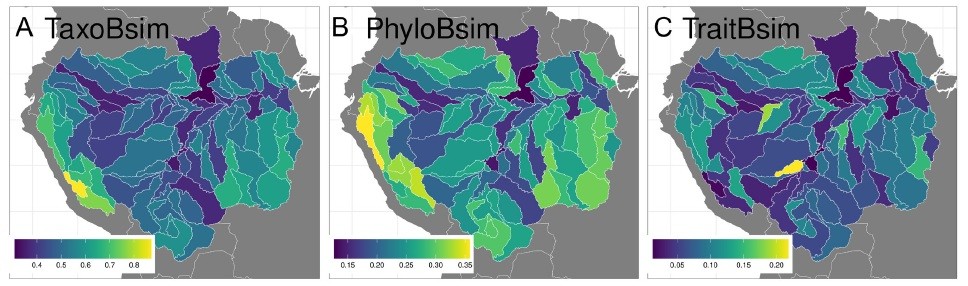
Identifying the main taxonomic, phylogenetic and trait dimensions of beta diversity, and evaluating their prospective drivers, advances our understanding of patterns and processes involved in the evolution of biological assemblages. Using comprehensive databases on the distribution, phylogeny, and morphological traits of Amazonian freshwater fishes, we analyzed turnover beta diversity patterns of these three dimensions to evaluate prospective historical and contemporary drivers using multiple regression on distance matrices. We found mean taxonomic beta diversity about two times higher than mean phylogenetic and six times higher than species traits beta diversity, and coincident spatial patterns in Taxoβsim and Phyloβsim dimensions, whereas Traitβsim seemed more diffuse and heterogeneous across space. We find prominent influence of sub-basins geographic distances, habitat harshness and water color types on the taxonomic and phylogenetic dimensions of beta diversity, together with smaller individual effects of current temperature and habitat types, historical sub-basins connections and marine incursions, and sampling effort. By contrast, Traitβsim
was weakly explained only by sampling effort and current sub-basins hydromorphological conditions. These results point to leading effects of dispersal limitation, environmental filtering and historical contingencies in explaining Amazonian fish assemblages taxonomic and phylogenetic beta diversity patterns, but not functional traits turnover.
See full text